
A passable failure
The Catholic School has the potential to be a truly strong thriller. Based on the Circeo Massacre, Netflix’s newest original series delves inside the minds of the guys who committed the heinous crime in the 1970s.
while taking place in the centre of Rome and attempting to piece together the circumstances leading up to it.
For those who haven’t seen the entire film, in particular, I won’t reveal what that crime is, but the second half of this movie delves into the uncomfortable atrocities that occurred.
A prestigious all-male Catholic high school in Rome serves as the backdrop for this, which is revealed through a sequence of perplexing back-and-forth flashbacks (we’ll get to that).
The history of evil
Each child is given a thorough introduction, along with a description of their family background, before being thrust into the eventual turmoil by director Stefano Mordini.
The framework and presentation of the movie are haphazard and disconnected, despite the fact that it does a good job of incorporating themes of masculinity, religion, sexuality, toxicity, and the history of evil.
The difficulty of the lads being introduced in a brief session early on is only made worse by the many time jumps, which are accompanied by text such as “5 months earlier,” “136 hours before,” etc.
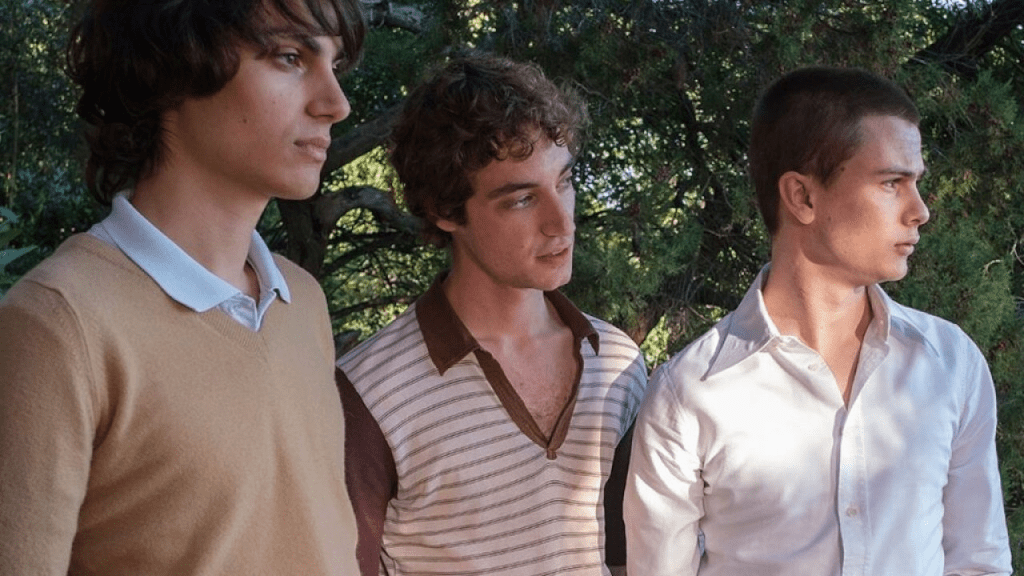
The format is so peculiar, that it seriously detracts from the film’s tempo, which shifts from tedious and slow-paced to interesting and startling.
A more linear framework, in my opinion, would have greatly improved this and helped heighten the tension leading up to the massacre.
We are introduced to a large number of individuals all at once in the early scenes, and the film surely takes its sweet time to untangle the mess it creates by having to explain who everyone is.
Struggles
While other children are included as well, the most of the drama revolves on a few individual classmates. Arbus is the intellectual one, and his attractive sister is the object of Edo’s crush.
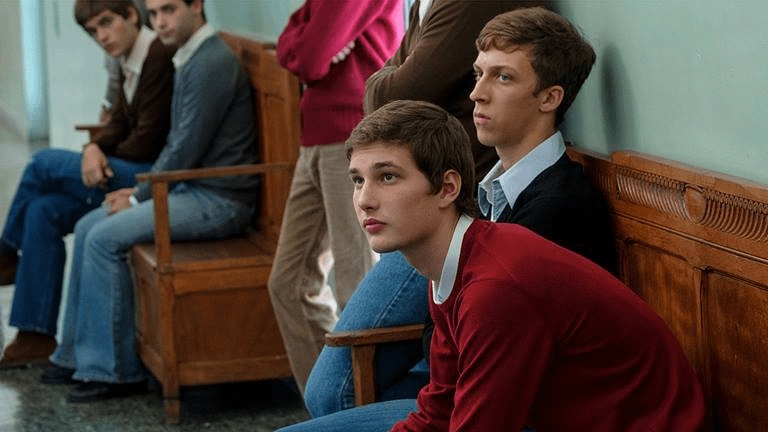
Jervi is your typical bad-boy, sporting a motorcycle and a leather jacket. Gioacchino Runmo is another; his family is solely Catholic. Naturally, he yearns for Jervi and struggles with his sexual orientation.
The movie spends a lot of time with each of these youngsters, learning about their psyches and examining their family histories.
A group of children are seen learning about evil through a painting of Jesus Christ in a particularly well-written foreshadowed sequence that ultimately serves as the impetus for a very dark and unsettling whipping scene.
The dearth of these memorable moments is disheartening
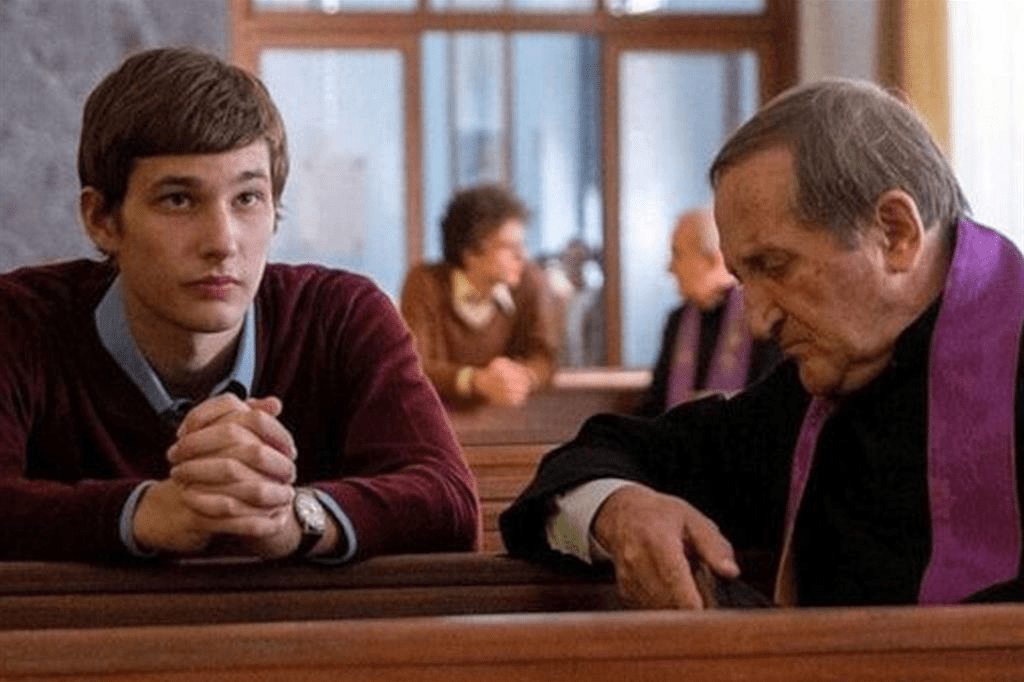
All of the actors do a respectable job of acting, which undoubtedly ties into the production’s and costumes’ 70s-inspired look. All of this, however, is meaningless because of the screenplay’s coherence.
However, The Catholic School ultimately falls into mediocrity and never seems to rise above it.
The pace, which frequently sags under the weight of expectation, is not helped by the repeated hops back and forth in time, which are annoying. Unfortunately, this was a chance lost.
 Hollywood Movie