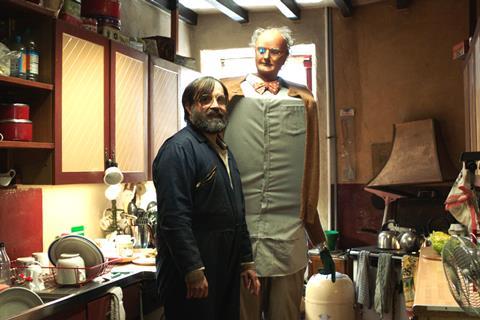
About one man and his washing machine partner, this is a nice and interesting comedy.
You may have watched comedies with an odd pair before, but it’s likely that none were as unique as Brian and Charles.
The unusual coupling of the title is played by co-creators David Earl and Charles Hayward in director Jim Archer’s movie, which is an adaptation of his 2017 short.
In the comic series Afterlife starring Ricky Gervais, Earl plays a character resembling the glum Brian Gittens.
When Brian isn’t making a job as a handyman on a remote Welsh farm, he spends his free time inventing all sorts of strange and amazing contraptions.
He is very imaginative, creating everything from shoes made of fishing nets to acorn bags (bags with acorns affixed to them).
There is only one issue: despite his efforts to produce something that will get him attention, his inventions, like his flying cuckoo clock, are largely useless.
When he builds a robot (Hayward) out of the numerous components he has gathered in his “infamous inventions pantry,” his luck changes (aka his cowshed).
A mannequin head and an ancient washing machine are among the components, but when he turns a switch to turn it on, it naturally doesn’t function.
The robot is just another unsuccessful creation in Brian’s eyes. But when he gets home after a thunderstorm, he finds that his crude construction has sprung to life.

Brian speculates that a mouse might have gotten inside the Tin Pot Man and accidently connected two wires, but a lightning bolt from the storm is more likely to blame.
The robot is given the name Charles by Brian, and the two quickly bond. They spend their days playing darts together, boiling cabbages, having pillow fights, and watching TV.
But the clumsily put together robot doesn’t take long to tyre of his surroundings.
“How far does the exterior extend? Is the tree where it stops? Brian is questioned by an inquisitive Charles. The robot begins to feel restless after discovering from his creator that the world is larger than the field in front of Brian’s hut.
He gets motivated by the travel shows he watches on television and decides he wants to travel to Honolulu so he can dance on the beach with the Hula girls there.
Brian attempts to talk Charles out of it, but Charles has a restless spirit and a wayward personality that make it difficult for him to accept his constricted circumstances.
Brian is really concerned about this, both because he doesn’t want to lose his new friend and because he is concerned for Charles’s well-being.
Unfortunately, one local family does find out about Charles, and because they are individuals who terrorise the neighbourhood, Brian’s robot and life are in jeopardy.

The family patriarch Eddie decides he wants Charles for himself, turning what was once a joyful comedy into something considerably darker.
Eddie and his abusive family’s plotline provides the movie dramatic weight, but it detracts from the amusing friendship between Brian and Charles.
Although David Earl also manages to elicit many laughs during his frequent asides to the camera (the movie is shot in the style of a mockumentary).
where he shares his off-the-wall thoughts to whoever is supposed to be watching him, much of the comedy comes from the contrast between Charles’s emotionless voice and childishly emotional outbursts.
Even if one of the two is a washing machine dressed in an old cardigan and a bow tie, there is a genuine warmth in their connection, and it’s amazing to watch how Brian’s lonely life has changed as a result of his unique partner.
It would not have been undesirable for them to spend 90 minutes together, but as I already indicated, their relationship is strained when Eddie and his family show up to jeopardise their prospects of happiness.
Although the film still has its sense of humour, the creeping scenes of grim dread significantly change how it feels, turning it from lighthearted to scary.

Despite certain gruesome sequences and sporadic similarities to classic Frankenstein films, this isn’t a horror film because, at its core, it’s a bromance film starring two peculiar people.
It’s simple to fall in love with them both—Brian for his upbeat and compassionate personality, and Charles for his endearingly innocent curiosity in spite of his peculiar and mildly frightful appearance.
Even though their tale is absurd and outlandish, you will have no trouble believing it, and as the plot unfolds, you will be hoping for a good ending for them both.
Don’t take Brian and Charles too seriously; it’s a weird and eccentric film. Cynics might wish to pass it by, but if you can get past the fairytale elements of the plot, you should enjoy it.
 Hollywood Movie